How Does Financial Spread Betting Work?
The Mechanics of Financial Spread Betting
Financial spread betting is a derivative strategy that allows traders to speculate on the future direction of market prices. Unlike purchasing stocks or commodities outright, financial spread betting involves betting on whether the price of an asset will rise or fall. The trader does not take ownership of the asset; instead, they bet a certain amount of money per point of price movement in their chosen direction.
The essence of spread betting lies in its simplicity: the profits or losses are determined by the number of points the price moves and the stake per point. When placing a bet, the trader is presented with two prices – the buy and the sell. The difference between these prices is known as the spread, which is where the term ‘spread betting’ comes from.
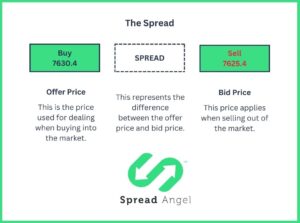
The bet is placed per point movement, which, in the case of stocks, is typically equivalent to a penny move in the stock price. For example, if a trader bets £10 per point and the stock price moves 10 points in their favour, the trader stands to gain £100. Conversely, a 10-point move against the bet would mean a £100 loss.
The direction of a bet is also key, and in financial spread betting, the terms “long” and “short” are used to describe the direction of a bet in relation to market movements. Going long refers to placing a bet with the expectation that the market price will rise over a specific timeframe. In contrast, going short implies a bet placed on the market’s decline.
This mechanism enables speculation on both upward and downward market trends. To go long, one buys into the market, while going short involves selling.

Positions in spread betting can be held for varying time frames, from minutes and hours to days or even weeks, depending on the trader’s strategy and the market conditions. Since the markets can move quickly, spread betting platforms often offer tools for risk management, such as stop-loss orders, which automatically close a position at a certain price level to prevent further losses.
The flexibility of spread betting allows traders to respond to market movements as they happen, without the need for large amounts of capital to hold the actual assets. This is called leverage and makes it an accessible way for individual investors to engage with the financial markets. However, it requires a thorough understanding of market dynamics and a disciplined approach to risk management.
The Role of Leverage and Margin in Financial Spread Betting
Leverage and margin are pivotal concepts in spread betting that amplify a trader’s capacity to make significant market plays while using less capital.
Leverage allows traders to gain much greater exposure to a market than the amount they deposit to open a position. This means that even small market movements can have a substantial impact on their trading account balance. In practice, leverage is applied by using a small sum, known as margin, to hold a position that has a much higher value.
Margin is effectively a security deposit required to open and maintain a leveraged position. There are two types of margins: the initial margin (the amount required to open a new position) and the maintenance margin (the amount required to keep a position open). If your positions become less favourable and your equity falls below the maintenance margin, you may receive a margin call, prompting you to add more funds to your account or close positions to cover the deficit.
For instance, if a spread betting provider offers a leverage of 10:1, you could open a position worth £10,000 with just £1,000. If the market moves in your favour, your profits are based on the full value of the trade (£10,000), not just the amount you deposited. However, this also means that losses are amplified, and you could lose more than your initial investment.

Understanding leverage and margin is crucial because, while they can magnify profits, they also increase the potential for high losses, making risk management essential. Traders must be vigilant in monitoring their positions and prepared to act if the market moves against them. Additionally, it will also be a question of finding the right broker that offers the leverage levels traders are looking to work with and what controls are in place to help manage risk. For a more in-depth exploration of the benefits and strategic approaches to risk mitigation in financial spread betting, visit our guide on The Benefits and Risks of Financial Spread Betting.
Step-by-Step Example of the Process of Placing a Financial Spread Bet
One of the most common markets in financial spread betting is the foreign exchange market, or forex for short. It’s a global marketplace where currencies are traded and is known for its high liquidity and 24-hour trading. With its vast array of currency pairs ranging from the major ones like EUR/USD to more exotic pairs, forex provides ample opportunities for traders to speculate on currency movements. Here is a detailed ten-step process for placing a financial spread bet in the forex market:
1. Select a Currency Pair: Choose which currency pair you want to trade. For beginners, it’s often recommended to start with major pairs like EUR/USD or GBP/USD due to their high liquidity and lower spreads.
2. Market Analysis: Before placing a bet, analyse the market for your chosen currency pair. You can use various methods, such as technical analysis, which involves charts and historical data, or fundamental analysis, which involves economic indicators and news events.
3. Directional Decision: Decide whether you think the base currency in the pair will rise (go long) or fall (go short) against the quote currency based on your analysis.
4. Set Your Stake: Determine the amount you are willing to bet per point movement. In forex, a point is typically a pip, which is the smallest price move that a given exchange rate can make based on market convention.
5. Risk Management: It’s important to manage your risk by setting stop losses to close your bet automatically if the market moves against you. You may also set take profit levels to secure profits when the market moves in your favour.
6. Understand the Spread: Note the spread offered by your broker, which is the difference between the buy and sell price. This will be your cost to enter the trade.
7. Place the Bet: With all the information at hand, place your spread bet with your chosen stake and any stop-loss or take profit orders.
8. Monitor the Trade: After your bet is placed, you will need to monitor the market, as your profit or loss will fluctuate with the market movements.
9. Closing Your Bet: When you feel it’s the right time, or if your stop-loss or take profit levels are reached, you close your bet to lock in a profit or a loss.
10. Post-Trade Analysis: After exiting the position, reflect on the trade and any market movements that occurred during the time your bet was open. This can help refine future trading strategies.
By following these steps, traders can engage in forex spread betting with a structured approach. However, due to the complexity and risks involved, it’s essential for traders to educate themselves thoroughly and possibly practice with a demo account before trading with real funds. Visit our Broker Overview to find your best demo account broker and educational offering.
Examples of Winning and Losing Scenarios in Long and Short Spread Bets
In financial spread betting, both winning and losing scenarios can manifest in both long and short positions.
For instance, consider a trader who goes long on a technology stock, betting that its price will rise. If the stock’s price climbs, the trader realises a profit proportional to the increase.

However, if the stock declines, the trader faces a loss corresponding to the degree of the drop.

Conversely, in a short position, a trader might bet against a stock, expecting its value to fall. Should the stock indeed decrease in value, the trader gains, with profits reflecting the extent of the depreciation.
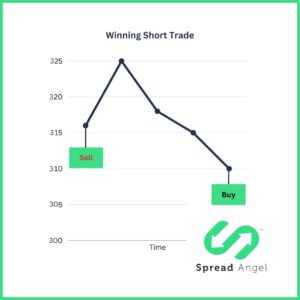
On the flip side, if the stock unexpectedly appreciates, the trader incurs losses, directly related to the magnitude of the increase.
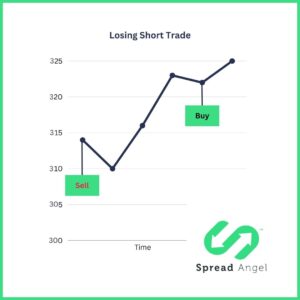
These examples underscore the dual nature of financial spread betting, where both long and short positions carry potential for profits as well as risks of losses, contingent on market movements and the accuracy of the trader’s predictions.
Conclusion
In summary, the journey through the intricacies of financial spread betting highlights its dynamic nature, offering opportunities to speculate on both rising and falling markets with mechanisms like leverage and margin. The step-by-step process of placing a spread bet, particularly in the forex market, showcases the blend of analysis, strategy, and risk management essential in this form of trading.
The examples of potential wins and losses in both long and short positions further underline the need for astute market judgement and a robust understanding of trading dynamics.
As each trader’s journey is unique, finding the right broker to begin or enhance your financial spread betting journey is crucial. The right broker not only aligns with your trading style but also offers the necessary tools and educational resources to navigate the complexities of the market. Explore our comprehensive Broker Comparison Calculator to embark on your trading journey with maximum profit.